Protect Your PowerPoint VBA Code from Reverse Engineering
Compile PowerPoint macros into native DLLs - your slide generators, branding tools, and presentation add-ins ship as compiled bytecode instead of readable VBA.
Why VBA Password Protection Fails for PowerPoint
PowerPoint presentations and add-ins with VBA macros face the same vulnerability as other Office applications: the built-in VBA project password can be removed in seconds using freely available tools. Once bypassed, anyone can read and copy your slide generation algorithms, branding logic, and reporting routines.
This is especially problematic for commercial .ppam add-ins where the VBA code is the product. Variable renaming and code "obfuscation" only slow down a determined user by minutes - the logic remains fully readable in the VBA Editor.
The Solution: Compile PowerPoint VBA to Native DLLs
VBA Padlock takes a fundamentally different approach. Instead of hiding VBA source code behind a breakable password, it compiles your macros into native 32-bit and 64-bit DLLs. The original VBA code is transformed into bytecode that cannot be decompiled back to readable source.
VBA Padlock saves a protected copy of your .pptm or .ppam containing only generated wrappers - procedures with the same names and signatures that delegate to the DLL - plus the VBA bridge that loads it. All your intellectual property lives inside the compiled DLL, invisible to anyone opening the VBA Editor.
Open
Open your existing .pptm or .ppam in VBA Padlock. It extracts and analyzes your macros procedure by procedure - your source file is never modified.
Review & Produce
The Protection Review shows what moves into the DLL and what stays. Click Produce to compile the DLLs and save a protected copy with generated wrappers and the VBA bridge.
Distribute
Ship the protected copy (MyAddin_protected.ppam) with the bin/ folder. Users run macros normally - the DLL handles everything.
See It in Action
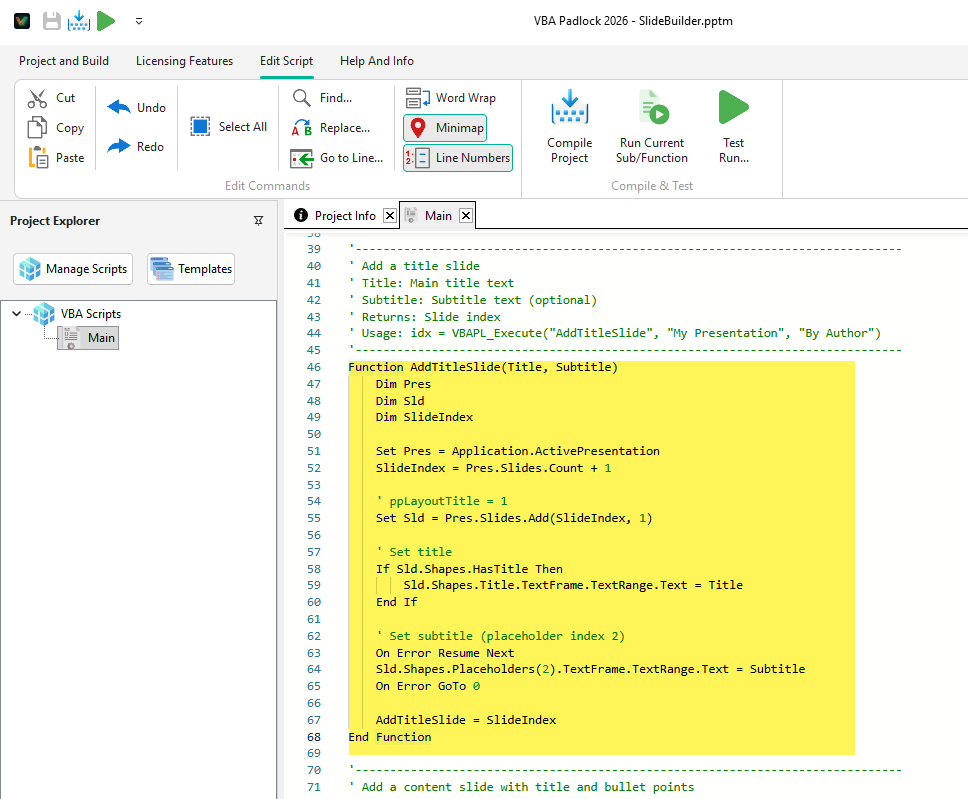
Left: functions that now run from the compiled DLL. Right: VBA in the protected file calling them through the bridge.
Function AddTitleSlide(Title, Subtitle)
    Dim Pres, Sld, SlideIndex
    Set Pres = Application.ActivePresentation
    SlideIndex = Pres.Slides.Count + 1
    Set Sld = Pres.Slides.Add(SlideIndex, 1)

    If Sld.Shapes.HasTitle Then
        Sld.Shapes.Title.TextFrame _
            .TextRange.Text = Title
    End If

    On Error Resume Next
    Sld.Shapes.Placeholders(2) _
        .TextFrame.TextRange.Text = Subtitle
    On Error GoTo 0

    AddTitleSlide = SlideIndex
End Function

Function ApplyBranding(SlideIndex, LogoPath)
    Dim Sld, Shp
    Set Sld = Application.ActivePresentation _
        .Slides(SlideIndex)
    Set Shp = Sld.Shapes.AddPicture( _
        LogoPath, False, True, 20, 20, 80, 80)
    Shp.Name = "CompanyLogo"
    ApplyBranding = True
End FunctionSub CreateTitleSlide()
Dim SlideIdx As Variant
SlideIdx = VBAPL_Execute( _
"AddTitleSlide", _
"Q4 Business Review", _
"Prepared by Finance Team")
' Apply company branding
Call VBAPL_Execute( _
"ApplyBranding", _
SlideIdx, _
"C:\Assets\logo.png")
MsgBox "Slide " & SlideIdx & _
" created with branding!"
End SubPowerPoint VBA Protection in Action
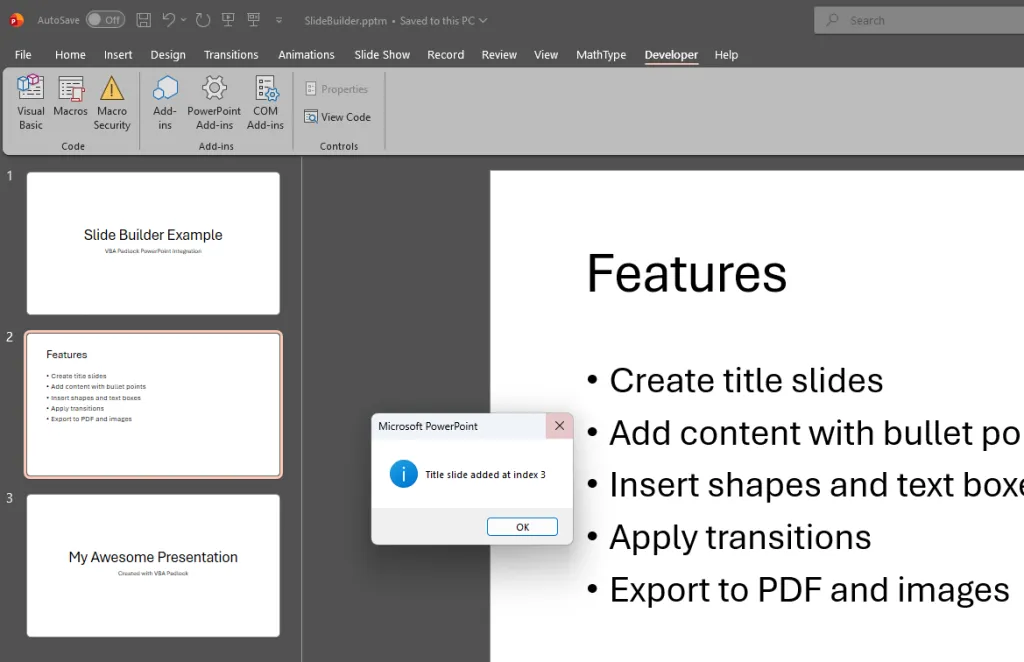
Real presentation and add-in workflows protected with VBA Padlock.
What You Can Protect in PowerPoint
VBA Padlock supports all PowerPoint VBA scenarios - from presentation macros to commercial .ppam add-ins and reporting tools.
Presentation Add-ins (.ppam)
Compile PowerPoint add-ins into secure DLLs. Ship commercial .ppam add-ins with protected macros, toolbar buttons, and custom ribbon commands.
Slide Generation Engines
Protect automated slide creation logic that builds complete presentation decks from data sources, templates, and business rules.
Branding & Style Tools
Distribute corporate branding add-ins that apply styles, fonts, colors, and layouts - without exposing the formatting logic.
Reporting Tools
Secure PowerPoint-based reporting tools that generate charts, tables, and data visualizations from external data sources.
PDF Export & Conversion
Ship presentation-to-PDF conversion tools with custom layout, formatting, and watermarking logic protected inside the DLL.
Licensing & Activation
Add hardware-locked license keys, trial periods, and online activation to any PowerPoint add-in or macro project.
PowerPoint-Specific Note
-
Use
Application.ActivePresentation(not justActivePresentation) inside compiled scripts for reliable COM object access.
Need a step-by-step walkthrough?
Read the dedicated PowerPoint tutorial
Follow the full process to protect a PowerPoint presentation or add-in with VBA Padlock.
Watch the video tutorial
A 13-minute walkthrough of the concepts using the earlier manual workflow. Since 2026.2, the analysis, wrappers, and bridge injection happen automatically when you click Produce.
Frequently Asked Questions
Can VBA Padlock compile PowerPoint add-ins (.ppam)?
Does compiled code have access to the PowerPoint object model?
How do I protect a slide generation tool built with PowerPoint VBA?
Will end users need to install anything besides PowerPoint?
Can I add license key activation to a PowerPoint add-in?
Ready to Monetize Your VBA Projects?
Download VBA Padlock and start selling protected Office solutions. One-time purchase, no royalties, no subscription.
Related Pages
Protect Excel workbooks, add-ins, and UDFs
Protect document templates and mail merge
Protect Access database logic and queries
How the compilation pipeline works
Why you need a VBA compiler and how it works